

Transitioning to renewable energy has shifted from a luxury to a financial necessity for homeowners across the Front Range. According to recent market data, solar installations in Colorado have seen a significant growth in adoption rates over the last decade. This surge is driven by two primary factors: the state's abundant sunshine and the availability of innovative financing models. One such model allows homeowners to eliminate upfront capital requirements while locking in predictable energy costs. This guide details how to achieve solar ownership with zero down payment and no monthly rate escalators, ensuring your investment remains secure against inflation. (About Us Impact Energy)
Understanding Zero Down Solar Financing
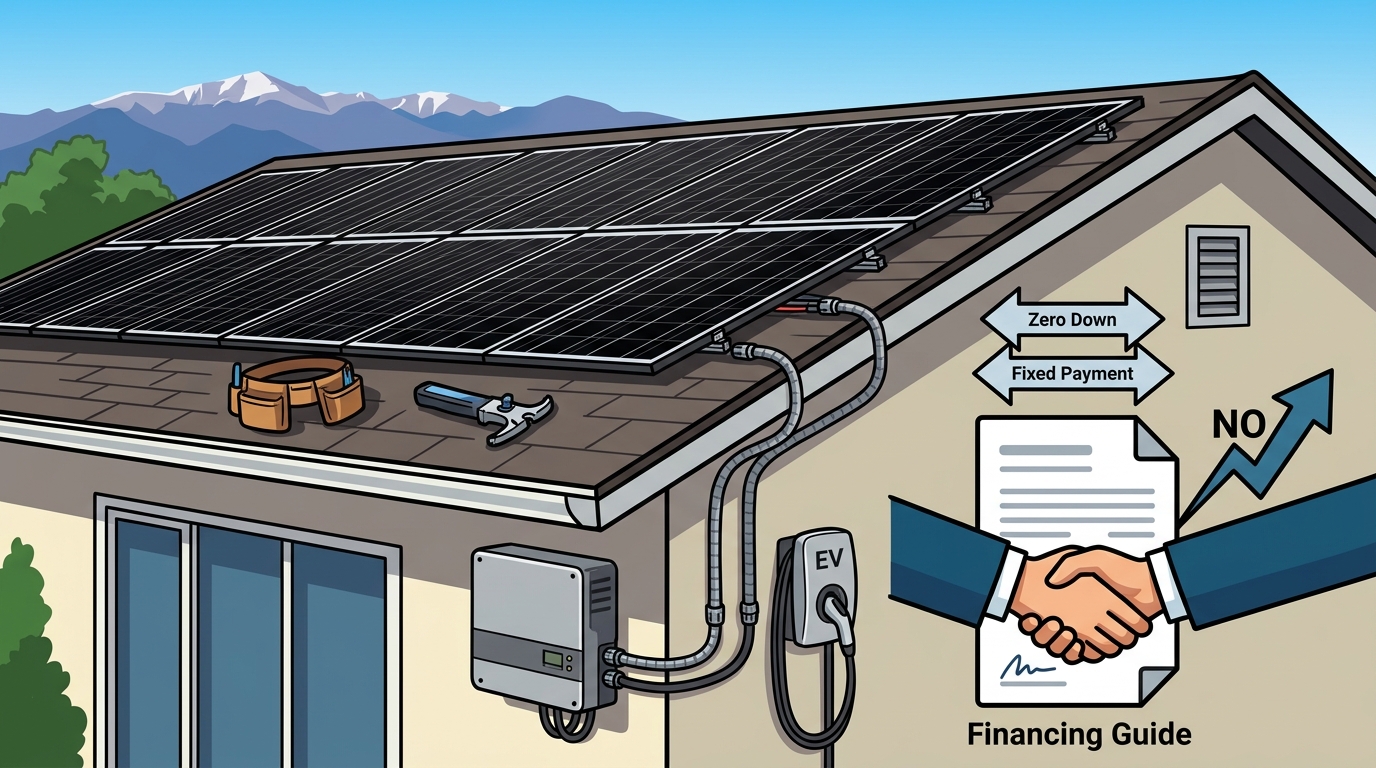
Traditional solar purchases required substantial upfront capital. Today, solar loans and power purchase agreements (PPAs) have democratized access to clean energy. Solar loans allow you to borrow the full cost of the system, meaning you pay nothing out of pocket at closing. The loan is secured by the property, and the solar panels themselves serve as collateral. This structure is distinct from a PPA, where a third party owns the system and you pay for the power generated. With a zero-down loan, you own the asset immediately, claiming all tax incentives and increased home value. (Solar Installation in Denver)
The term zero down payment refers to a financing structure where the borrower covers 100% of the installation costs through a lender. This eliminates the barrier of entry for homeowners who have cash flow but lack liquid savings. In Colorado, where energy rates have historically risen, locking in a fixed loan payment often results in immediate monthly savings compared to utility bills. This approach requires a credit check and a solid financial history, but it offers the highest long-term return on investment.
The Risk of Monthly Rate Escalators
Many solar contracts include a monthly rate escalator, a clause that increases your payment annually by a fixed percentage, typically 2% to 3%. While this might seem minor, it compounds over the 20 to 25-year lifespan of a solar system. An escalator clause protects the provider against inflation but transfers that risk to the homeowner. If utility rates do not rise as quickly as your solar payment, you may find yourself paying more for solar power than you would have for grid electricity.
Avoiding escalators is critical for long-term financial planning. A fixed-rate loan or a no-escalator PPA ensures that your energy costs remain predictable. According to the Energy Sage, fixed payments provide stability that helps homeowners budget effectively. Without an escalator, your savings potential grows as utility rates continue to climb, while your solar payment remains static. This dynamic creates a widening gap between your energy costs and your savings, maximizing the financial benefit of going solar.
The Impact Energy Approach
Impact Energy operates on a principle of integrity and transparency, specifically designed to protect Colorado homeowners from hidden costs. As a premium solar installation company in Centennial, CO, we do not subcontract any part of the process. This vertical integration ensures quality control and allows us to offer financing terms that prioritize customer benefit. We explicitly avoid monthly rate escalators, ensuring that your payment remains constant throughout the loan term.
Our financing options are structured to provide no upfront cost and no monthly rate increases. This means your energy bill becomes predictable, regardless of market fluctuations. We utilize satellite imagery and shade analysis to calculate the Total Solar Resource Fraction (TSRF) for your specific property. This data-driven approach ensures that the system size matches your energy needs precisely, preventing overpayment for unused capacity. By combining zero-down financing with fixed payments, we align our success with your long-term savings.
The Installation Process
Switching to solar involves a structured workflow designed to minimize disruption and maximize efficiency. The process begins with a comprehensive property assessment. Our team uses advanced satellite imagery to review your roof pitch, azimuth, and orientation. This initial step identifies potential obstructions like trees or neighboring buildings that could impact sunlight exposure.
Once the assessment is complete, our engineering team designs a custom solar system. This proposal includes a detailed layout, energy production estimates, and a clear cost breakdown. After approval, our in-house installation team brings the project to life. We handle all permitting, inspections, and utility interconnection paperwork. After a final inspection, we activate your system, allowing you to start saving immediately. This streamlined process typically takes a few weeks from contract signing to activation.
Financial Comparison of Options
Choosing the right financing method requires comparing the long-term costs and benefits of each option. The table below outlines the key differences between cash, zero-down loans, and traditional PPAs.
| Financing Option | Upfront Cost | Monthly Payment Stability | Ownership & Incentives | Best For |
|---|---|---|---|---|
| Cash Purchase | High | Fixed (No Payment) | Full Ownership | Homeowners with liquid capital |
| Zero-Down Loan | Zero | Fixed (No Escalator) | Full Ownership | Maximizing ROI without capital |
| Traditional PPA | Zero | Variable (Often Escalator) | Third-Party Ownership | Minimal risk tolerance |
As noted by the Consumer Financial Protection Bureau, understanding the terms of your loan is crucial. A zero-down loan with no escalator offers the best of both worlds: immediate savings and long-term asset ownership. This option allows you to benefit from the Federal Investment Tax Credit (ITC) and Colorado-specific incentives, which are not available with PPAs.
Key Takeaways
- Zero Down Payment: Allows homeowners to install solar systems without using personal savings, utilizing loan financing instead.
- No Escalator Clauses: Fixed payments protect against inflation, unlike PPAs which often include annual rate increases.
- Impact Energy Integrity: We do not subcontract, ensuring quality and transparent financing terms for all Colorado clients.
- Data-Driven Design: We use satellite imagery and TSRF calculations to optimize system performance for your specific roof.
- Immediate Savings: Most zero-down loans result in immediate monthly cash flow positive outcomes due to lower payments than utility bills.
- Asset Ownership: Loan holders own the system, claiming all tax credits and increasing home resale value.
- Local Expertise: Serving Centennial, Denver, Aurora, and surrounding areas with over 3000 completed projects.
Frequently Asked Questions
What is a zero down payment solar loan?
A zero down payment solar loan is a financing product that covers 100% of the solar installation costs. The homeowner makes monthly payments to the lender, which are often lower than their current utility bill, resulting in immediate savings.
Do solar payments increase over time?
Not with Impact Energy. We offer financing options with no monthly rate escalators. Your payment remains fixed for the duration of the loan, protecting you from inflation and rising utility rates.
How does Impact Energy ensure quality?
We do not subcontract any part of the solar installation process. Our in-house team handles everything from design to installation, ensuring consistent quality and accountability.
What is the Total Solar Resource Fraction (TSRF)?
TSRF is a metric used to calculate the amount of solar energy available at a specific location. We use this data to design systems that maximize energy production based on your roof's unique characteristics.
Can I install solar in Aurora or Greeley?
Yes, Impact Energy provides solar installation services across Colorado, including Aurora, Greeley, Lakewood, Pueblo, and Denver. We tailor our designs to local climate conditions.
What warranties do you offer?
We provide a 30-year product warranty on solar panels and a ten-year workmanship warranty on the installation process. This ensures long-term protection for your investment.
How long does the installation take?
The timeline varies based on permitting and system size, but most residential installations are completed within a few weeks. Our team handles all administrative tasks to minimize delays.
Start Your Solar Journey
Take control of your energy future with a financing plan that respects your budget. Impact Energy offers premium solar solutions with zero down payment and no monthly rate escalators. Contact us today to schedule your free savings report and discover how much you can save. Visit our contact page or call Impact Energy to begin your transition to clean energy.