

Transitioning to renewable energy in Colorado has never been more accessible. According to recent industry data, solar photovoltaic costs have dropped by over 80% in the last decade, making the financial argument for homeowners stronger than ever. Many residents in the Denver metro area are now asking how to switch to solar with zero down payment and no monthly rate escalators. This guide explains the specific financial products and installation workflows that make this possible, focusing on the operational excellence of local providers like Impact Energy. (Will I Save)
Understanding Zero Down Solar Financing
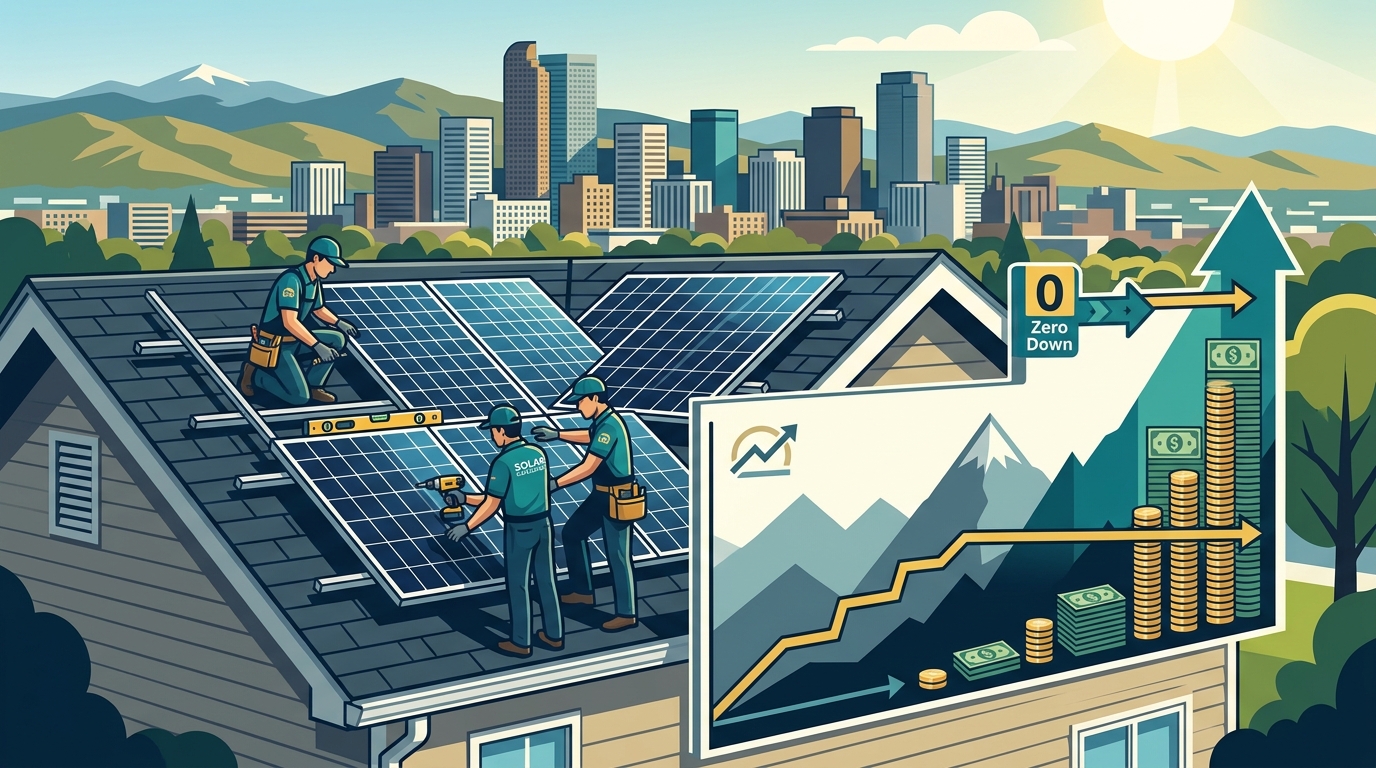
Zero down payment solar allows homeowners to install a complete energy system without contributing initial capital. Zero down payment solar is a financing model where the cost of the system is covered by a third-party lender or the installer, allowing the homeowner to begin saving on electricity bills immediately. This approach removes the barrier of entry for homeowners who have strong credit but limited liquid cash.
In Colorado, this model is particularly popular due to the high electricity rates charged by utilities like Xcel Energy. By eliminating the upfront cost, homeowners can redirect funds that would have been used for the purchase toward other financial goals or emergency savings. The system is typically structured as a loan or a lease, where monthly payments are often lower than the previous utility bill.
However, not all zero-down options are created equal. The critical differentiator lies in the terms of the monthly payment. Some agreements include annual percentage increases, while others offer fixed rates. Understanding this distinction is vital for long-term financial planning.
The Risk of Monthly Rate Escalators
Many traditional solar leases and power purchase agreements (PPAs) include a built-in annual escalator. This is a clause that increases your monthly payment by a fixed percentage, often between 2% and 3%, every year. While the initial rate might be lower than your utility bill, the escalator can eventually cause your solar payment to exceed your grid electricity costs. (Will I Save)
According to financial analyses of renewable energy contracts, consumer finance reports highlight the importance of fixed-rate structures in long-term energy savings. When an escalator is present, the homeowner loses the benefit of compounding savings. Over a 20-year period, these small annual increases can amount to thousands of dollars in unnecessary costs.
A fixed-rate loan or a cash purchase avoids this pitfall entirely. With a fixed rate, your payment remains constant while your utility bills typically rise due to inflation and infrastructure costs. This divergence creates a widening gap between your solar cost and your grid cost, maximizing your return on investment. Choosing a provider that explicitly offers no monthly rate increases is a strategic financial decision.
The Impact Energy Difference
Impact Energy has established itself as a premium solar installation company in Centennial, CO, by adhering to a strict operational philosophy. They prioritize integrity and transparency in every aspect of the customer journey. A core tenet of their service model is the elimination of hidden costs and unpredictable payment structures.
When you choose Impact Energy, you are working with a company that does not subcontract any part of the process. This in-house approach ensures that the team designing your system is the same team installing it. This continuity reduces errors and ensures that the financial proposal matches the physical reality of your roof.
Their commitment to "No Up-Front Cost" and "No Monthly Rate Increases" aligns directly with the goals of homeowners seeking financial stability. By offering Colorado solar loans with fixed terms, they allow customers to lock in their energy costs. This predictability is a significant advantage in an economic environment where utility rates are volatile.
Furthermore, Impact Energy provides a ten-year workmanship warranty. This covers any issues caused by the installation process, giving homeowners peace of mind. The combination of a fixed financial structure and robust warranty support creates a low-risk pathway to energy independence.
The Installation Workflow
Switching to solar involves a structured process that begins long before the panels are mounted. Impact Energy utilizes a data-driven approach to ensure optimal system performance. The process starts with satellite imagery to review your property’s layout. This allows the team to assess key factors like roof pitch, azimuth, and orientation.
Next, a detailed shade analysis is conducted. This step identifies potential obstructions, such as trees or neighboring buildings, that could impact sunlight exposure. The team calculates the Total Solar Resource Fraction (TSRF) to determine the most effective placement for your panels. This technical precision ensures that the system you pay for will perform as promised.
Once the design is approved, the installation team brings the project to life. The process includes securing all necessary permits and coordinating with local building inspectors. After installation, a final inspection is conducted to activate the system. This seamless transition allows homeowners to start enjoying energy savings immediately.
The company serves a wide range of areas across Colorado, including Aurora, Denver, Greeley, Lakewood, and Pueblo. This broad service area ensures that local expertise is available regardless of your specific location within the state.
Colorado Solar Incentives & Loans
Colorado offers several incentives that can further enhance the value of a zero-down solar investment. The federal Investment Tax Credit (ITC) allows homeowners to deduct a significant percentage of the system cost from their federal taxes. Although the system is financed, the tax credit still applies to the total installed cost.
Additionally, net metering policies in Colorado allow homeowners to sell excess energy back to the grid. This credit offsets future electricity usage, further reducing the effective cost of the system. Understanding these incentives is crucial for maximizing your financial return.
For those interested in exploring financing options, Colorado solar loans provide flexible terms tailored to different credit profiles. These loans are designed to be competitive with traditional utility bills, ensuring that the switch to solar is financially viable for a wide range of homeowners.
Key Takeaways
- Zero Down Accessibility: Homeowners can install solar systems without initial capital, leveraging financing to start saving immediately.
- Fixed Rate Importance: Avoiding monthly rate escalators protects long-term savings from inflation and utility rate hikes.
- In-House Operations: Impact Energy handles all permits and installations in-house, ensuring quality control and accountability.
- Technical Precision: The use of satellite imagery and shade analysis ensures optimal system design and energy production.
- Warranty Coverage: A ten-year workmanship warranty covers installation-related issues, providing additional security.
- Broad Service Area: Services are available in Aurora, Denver, Greeley, Lakewood, Pueblo, and surrounding Colorado communities.
- Financial Transparency: Clear proposals with no hidden fees or rate increases build trust and financial predictability.
Frequently Asked Questions
Is zero down solar truly free?
Zero down solar is not free, but it requires no upfront cash. You pay for the system through monthly loan payments or lease agreements, which are often lower than your current utility bill.
What is a monthly rate escalator?
A monthly rate escalator is an annual increase in your solar payment, typically 2-3%. It is designed to protect the installer from inflation but can reduce your long-term savings.
Does Impact Energy subcontract installers?
No, Impact Energy does not subcontract any part of the solar installation process. All work is performed by their in-house team to ensure quality and consistency.
What areas does Impact Energy serve?
Impact Energy serves Centennial, Aurora, Denver, Greeley, Lakewood, Pueblo, and other parts of Colorado.
How does the installation process work?
The process begins with a satellite analysis and shade study, followed by a custom design, permit acquisition, installation, and final activation. The entire process is managed in-house.
Are there tax incentives for solar in Colorado?
Yes, homeowners can benefit from the federal Investment Tax Credit (ITC) and local net metering policies that credit excess energy back to the utility bill.
What warranty is provided?
Impact Energy offers a ten-year workmanship warranty to cover any issues caused by the installation process, in addition to the manufacturer's product warranty.
Start Your Solar Journey
Switching to solar with zero down payment and no monthly rate escalators is a smart financial move for Colorado homeowners. By choosing a provider that prioritizes transparency and in-house operations, you can secure your energy future with confidence. Contact Impact Energy today to schedule your free savings report and discover how much you can save.